
As you count down the days until you meet your baby, ob-gyns and real mothers share symptoms that could mean labor will begin very, very soon. You’ll recognize labor when you first go into it. Labor marks the beginning of childbirth — and you’ll notice it when you start feeling contractions that become increasingly frequent and painful. Of course, labor doesn’t always start on your due date. “It remains one of the few bodily processes we cannot reliably control,” says Belinda Smith, DNP, CNM, clinical director and co-founder of Willow Midwife Centers for Birth and Wellness AZ. “While we recognize various signs of labor and can sometimes induce the process medically, the natural onset follows its own timeline.”
So how will you know when it’s time to grab your hospital bag and head to the delivery room? You can trust that your body will likely give several signs labor is near. Still, it can feel unnerving to determine whether it’s the real thing or just a false alarm (hello again, Braxton Hicks). “I’m due tomorrow, and so far I’ve had no indications of baby’s arrival anytime soon .
While signs of labor aren’t always crystal clear, the good news is that your body generally offers solid clues. Ready to understand the signs labor is near? Keep reading to learn what to expect and what to do.
Crucial Takeaways
1.The signs of labor vary for every pregnant person; some symptoms appear subtle.
2.Early signs of labor include nausea, vomiting, diarrhea, increased bowel movements, lower back pain, cervical dilation and effacement, and loss of the mucus plug.
3.Signs that active labor is progressing include your water breaking, increased pelvic or rectal pressure, and regular, painful contractions.
4.Some labor signs require an immediate call to your doctor: contractions lasting 30 seconds and five minutes apart for an hour; contractions so painful you can’t walk or talk; red, brown, or green liquid when your water breaks; and vaginal bleeding.
5.Even with clear signs of labor, it’s impossible to predict the exact moment baby will arrive. The length of early labor varies widely.
8 Signs Labor Is Near
If you’re wondering what early signs of labor look like, it helps to understand what occurs during early or latent labor, which is the first part of the first stage of labor. During early labor, you’ll likely dilate up to six centimeters, says Christine Greves, MD, a board-certified ob-gyn at the Winnie Palmer Hospital for Women & Babies. But these changes might not feel obvious.
Even though many expect early labor signs to be clear, most mimic common pregnancy symptoms, making it hard to identify when labor actually begins. You may recognize many of these subtle changes only in hindsight. Some signs, like nesting, are particularly easy to miss. This burst of energy often appears weeks before labor actually starts.
Even if early signs seem minor, knowing them helps you prepare. Below, experts highlight the signs labor is near.
1. Nausea and Diarrhea
You may feel like morning sickness happened ages ago, but many women experience gastrointestinal discomfort in the third trimester as well. They often ask, “Is diarrhea a sign of labor?” or “Is nausea a sign of labor?” As baby grows, your uterus compresses your GI tract, explains Colleen Moreno, DNP, CNM. Hormones that prepare your body for labor also relax the muscles in your rectum, which can lead to diarrhea — one of the early signs of labor.
2. Effacement and Dilation
During your last weeks of pregnancy, your doctor will check your cervix for effacement (thinning) and dilation (opening). While progress may feel reassuring, don’t get too excited yet. Cervical change can happen quickly or very slowly — over hours, days, or weeks. “Some women live normal daily life with a cervix dilated to four or five centimeters when full-term,” says Julie Lamppa, APRN, CNM, at the Mayo Clinic.
3. Lightening
When someone tells you “baby has dropped,” they’re referring to lightening — when baby settles deeper into your pelvis. This can happen days or even weeks before labor, says the American Pregnancy Association. You may suddenly breathe easier due to less pressure on your diaphragm, but you’ll feel more pressure on your bladder.
4. Loosening of the Joints
If your body starts feeling looser and more flexible, you’re not imagining it. During the final stretch of pregnancy, your body releases relaxin — the hormone that loosens your joints to prepare for labor. While relaxin isn’t proven to start labor, studies show it promotes cervical ripening. Be careful not to overstretch!
5. Lower Back Pain
Contractions often begin in the back and move forward. Some women experience “back labor,” which produces severe lower back pain that peaks during contractions and may continue between them.
6. Expulsion of the Mucus Plug
As your cervix thins and opens, the mucus plug — which blocks bacteria from entering the uterus — dislodges. It may come out all at once or gradually as thick discharge. While losing the mucus plug is a sign labor is near, labor could still be hours, days, or weeks away.
7. Blood-Tinged Discharge
When the mucus plug releases, small blood vessels may rupture, producing slightly bloody discharge called the “bloody show.” This can indicate labor is minutes to two weeks away, says William Schweizer, MD. A normal amount equals about the size of a quarter. If bleeding resembles a menstrual period, call your doctor immediately.
8. Regular Cramping and Contractions
One major sign labor is near: contractions that occur regularly. “When contractions increase in frequency and become consistent, that’s usually the beginning of the latent phase,” Greves says. Early labor contractions may start 15 minutes apart, lasting 60 to 90 seconds, before speeding up to five minutes apart. They may feel like intense tightening, squeezing, pelvic pressure, or severe cramps. Contractions typically grow stronger over time.
According to Johns Hopkins Medicine, early labor contractions may occur every 5 to 20 minutes and last 60–90 seconds.
What to Do During Early Labor Signs
Check in with your obstetrician or midwife and let them know you’re experiencing early labor contractions. Your doula may also want to know. They will tell you when to head to the hospital — often not right away, because many facilities admit only those in active labor.
Use this time to stay comfortable. Take a warm bath or shower, walk, practice labor positions like swaying or bouncing on an exercise ball, and rest if possible. Deep relaxation or short naps between contractions can help you conserve energy. Stay hydrated and eat light snacks.
How Long Does Early Labor Last?
Every woman experiences early labor differently. It may last hours or days, says Jessica Shepherd, MD, FACOG. One major factor is whether this is your first baby. First-time mothers often experience early labor for a day or two — or sometimes just a few hours. If you’ve had a vaginal birth before, contractions may intensify quickly.
Signs Active Labor Is Near
Once early labor symptoms confirm labor has begun, active labor comes next. This stage involves dilation from six to ten centimeters and generally progresses faster. Here are signs you’ve moved from early to active labor:
Regular, Painful Contractions
Your contractions will become longer, stronger, and more frequent — sometimes every 3–4 minutes. You may feel them in your abdomen, back, or thighs. Time your contractions and prepare to go to the hospital when they reach five minutes apart.
Rupturing of the Amniotic Sac (Water Breaking)
Your water may break as a small trickle or a gush. If you squeeze your pelvic muscles and can’t stop the flow, it’s probably not urine. Only about 10 percent of women experience water breaking before contractions. If your water breaks but contractions haven’t started, your doctor may advise waiting a few hours.
Call immediately if the fluid appears red, brown, or green.
Increased Pelvic and Rectal Pressure
This pressure may feel like the urge to have a bowel movement. Baby is moving down, and contractions will continue to dilate your cervix to 10 centimeters.
Signs of Labor That Require an Immediate Call to Your Doctor
Call your doctor right away if you experience:
- Contractions lasting 60–120 seconds and five minutes apart for an hour
- Contractions so intense you cannot talk or walk
- Water breaking with red, brown, or green fluid
- Heavy vaginal bleeding
- Any signs of preterm labor before 37 weeks
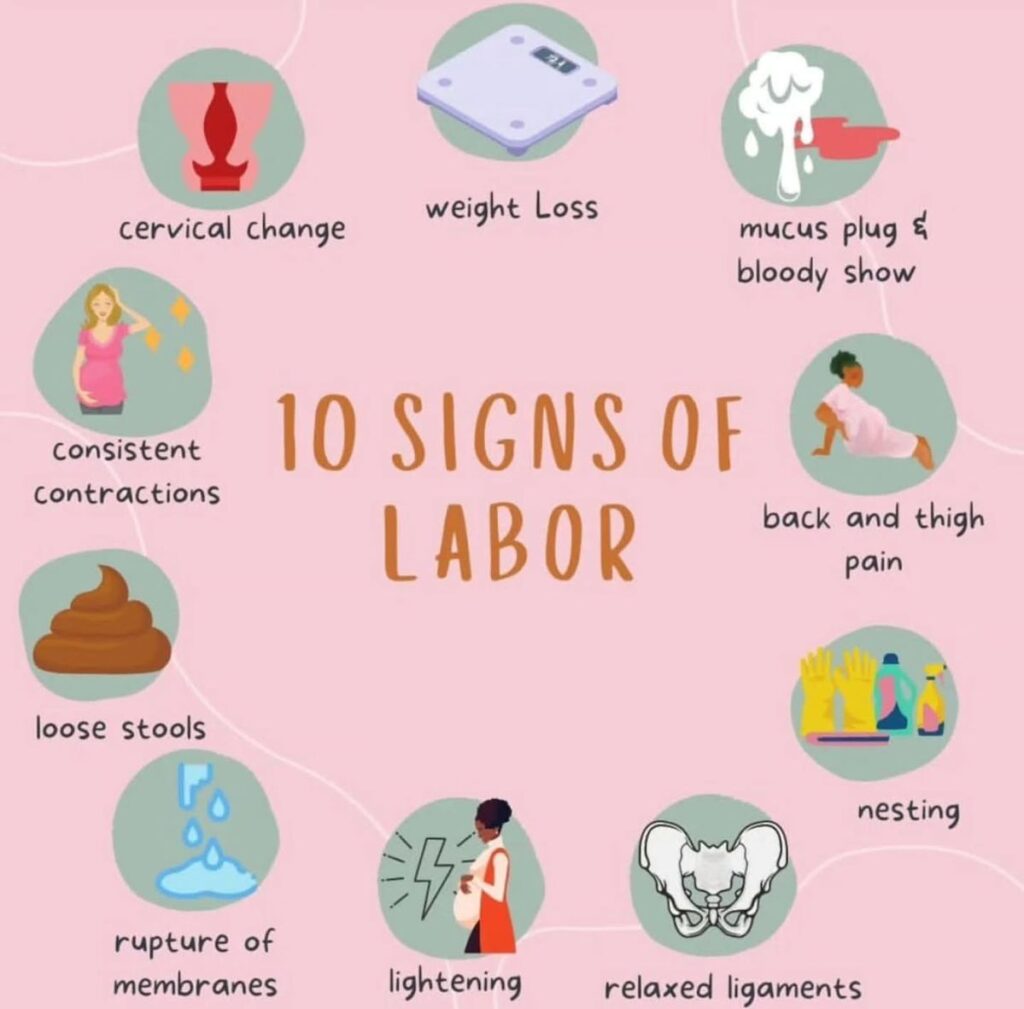
Signs-of-Labor Chart
Even though signs may feel subtle, several clues reveal labor is approaching. Use the chart below to understand all signs labor is near.
FAQs Signs labor is near ?
1. What are the main signs labor is near?
The main signs labor is near include regular contractions, nausea or diarrhea, lower back pain, losing the mucus plug, cervical dilation, and pelvic pressure.
2. How do I know labor will start soon?
You may know labor will start soon if contractions become stronger and more frequent, if you experience the bloody show, or if your water breaks.
3. Does losing the mucus plug mean labor is near?
Yes. Losing the mucus plug is a sign labor is near, but labor may still take hours, days, or weeks to begin.
4. What do early labor contractions feel like?
Early labor contractions feel like strong menstrual cramps, tightening in the belly, or pressure in your back or pelvis that slowly increases in intensity.
5. When should I call my doctor during labor?
Call your doctor when contractions are five minutes apart for one hour, if water breaks with colored fluid, or if you experience heavy bleeding.
6. How do I know labor is 24–48 hours away?
You may experience stronger and more regular contractions, increased pelvic pressure, the “bloody show,” or your water breaking when labor is 24–48 hours away.
Disclaimer : This content is for informational purposes only. Please consult a medical professional before taking any action.